Moving averages are one of the most common tools in day trading. Almost every trader has used them at some point, whether it was a simple 20 EMA on a chart or the famous 200 EMA that everyone talks about. But despite their popularity, moving averages are also one of the most misunderstood concepts in trading.
Many beginners assume that moving averages are meant to give direct buy and sell signals. They believe that if price crosses above a moving average, they should buy, and if price crosses below it, they should sell. The problem is that this approach almost always leads to frustration. Price constantly whips back and forth during the day, especially in Forex, and traders who rely on simple crosses often get trapped in sideways chop.
The truth is much simpler and much more useful:
Moving averages are not prediction tools. They are structure tools.
When used correctly, moving averages help day traders build clarity, improve discipline, and trade in alignment with real market direction instead of reacting emotionally to noise.
Understanding What Moving Averages Actually Represent
At its core, a moving average is simply the average price over a chosen number of candles. Every time a new candle forms, the moving average updates, which is why it “moves” with price. This smoothing effect is important because day trading is full of noise. Markets spike, candles retrace sharply, liquidity is hunted, and price often moves aggressively even when the trend has not truly changed.
A moving average helps filter that chaos. Instead of focusing on every small fluctuation, it gives you a clearer view of what price is doing on a broader intraday level. It helps you answer the most important question a day trader can ask:
Is this market trending, ranging, or transitioning?
That context is what separates professional decision-making from random guessing.
Choosing the Right Type of Moving Average
Not all moving averages behave the same way, and understanding the difference matters more than most traders realise.
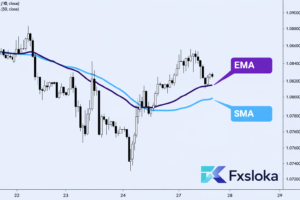
A Simple Moving Average (SMA) treats all candles equally. It is smooth and slow, which makes it useful for long-term trend context, but it can be too delayed for fast intraday trading.
An Exponential Moving Average (EMA), on the other hand, reacts faster because it gives more weight to recent price action. This responsiveness is why most day traders prefer EMAs. When the market shifts momentum quickly, EMAs adapt sooner, which makes them more practical for intraday trend tracking and pullback entries.
There are also more advanced moving averages, including adaptive or AI-based versions that adjust automatically based on volatility. These can be interesting, but they do not replace the fundamentals. Even the most advanced moving average will fail if a trader does not understand market structure, liquidity, and price behavior.
For Fxsloka traders, the best approach is always to start simple. EMAs provide more than enough clarity without adding unnecessary complexity.
The Biggest Mistake Traders Make With Moving Averages
The most common mistake is treating moving averages as entry signals instead of context tools.
Many traders think the moving average itself is the reason to enter a trade. They buy simply because price touched the EMA or sell because price crossed below it. But moving averages do not lead price. They follow it. They are lagging tools, which means they reflect what has already happened, not what is about to happen.
This is why traders who use moving averages incorrectly often feel like they are always late. They enter after the move has already started and exit after the reversal has already occurred.
The correct mindset is different:
Moving averages do not tell you when to trade. They tell you what kind of market you are trading in.
That shift changes everything.
Using Moving Averages to Define Trend Bias
One of the strongest uses of moving averages in day trading is defining directional bias. Before taking any setup, you should first determine whether the session is bullish, bearish, or neutral.
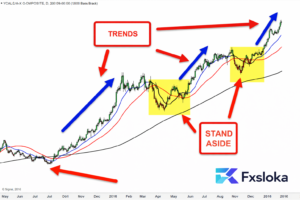
When price is trading above a rising moving average, it usually suggests that buyers are in control. The market is trending upward, and pullbacks are more likely to be buying opportunities rather than reversal points.
When price is trading below a falling moving average, sellers are dominating. In those conditions, rallies are often opportunities to sell into resistance rather than chase long positions.
The most dangerous environment is when the moving average is flat and price keeps crossing back and forth. That is the market telling you there is no clean trend. Many day traders lose money not because their strategy is bad, but because they keep forcing trades inside chop.
A moving average helps you avoid that mistake by making trend clarity visual.
Why the 200 EMA Matters So Much
The 200 EMA is one of the most widely watched indicators in the world. Institutions, algorithms, hedge funds, and retail traders all monitor it because it often acts as a psychological boundary between bullish and bearish territory.
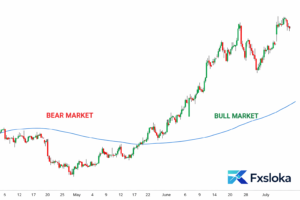
When price is above the 200 EMA, the market is generally considered to be in bullish territory. Buyers have the higher ground, and long setups tend to perform better.
When price is below the 200 EMA, bearish conditions dominate, and short setups become higher probability.
What makes the 200 EMA powerful is not the line itself, but the behaviour around it. Some of the best day trading opportunities occur when price strongly rejects the 200 EMA or reclaims it with momentum after sweeping liquidity. These moments often signal that the market is shifting regime, and day traders who understand this can position themselves early.
Moving Averages as Dynamic Support and Resistance
Support and resistance are not always horizontal. In trending markets, moving averages often act as dynamic levels where price repeatedly reacts.
In an uptrend, price rarely moves straight upward. Instead, it expands, pulls back, consolidates, and then continues. The pullback often finds support near the 20 or 50 EMA, where buyers step back in.
In a downtrend, the opposite occurs. Price rallies into the moving average zone, sellers defend that area, and the trend continues downward.
This is one of the most professional ways to use moving averages: not as a trigger, but as a value zone where pullbacks become tradeable opportunities.
Professionals do not chase breakouts. They wait for price to return to value.
Moving averages help define that value.
The Best Moving Average Setup for Day Traders
A clean moving average setup is often more effective than an overcomplicated chart full of indicators.
For most day traders, the following combination works extremely well:
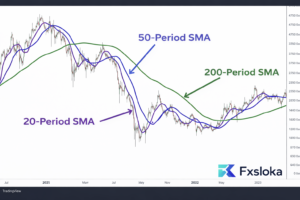
The 20 EMA helps track short-term momentum and provides a pullback zone. The 50 EMA confirms the medium-term trend structure. The 200 EMA defines the overall directional territory of the session.
With just these three, you can understand trend direction, identify pullback opportunities, and avoid trading against the larger bias.
Simplicity creates clarity, and clarity improves execution.
Matching Moving Averages to Your Trading Style
Moving averages should always match the timeframe you trade.
Scalpers on the one-minute chart need faster moving averages because price moves quickly and momentum shifts happen rapidly. Common combinations like the 5 EMA and 21 EMA help capture short-term flow.
Intraday traders on the five-minute chart often prefer slightly slower EMAs, such as the 8 EMA and 21 EMA, which provide cleaner pullback zones.
Higher-quality day trades on the fifteen-minute chart often work best with the 20 EMA and 50 EMA because the noise is reduced and the trend structure becomes clearer.
The key principle is simple:
The lower the timeframe, the faster the EMA needs to be.
Moving Average Crossovers (Used Correctly)
Moving average crossovers are popular because they appear simple. A fast EMA crossing above a slow EMA suggests bullish momentum, while crossing below suggests bearish momentum.
However, crossovers should never be traded blindly. They are lagging confirmations, not early signals.
Crossovers work best when they align with structure. If the crossover occurs after a liquidity sweep, a break of structure, or a strong session open move, it can confirm that momentum has truly shifted.
But if a crossover happens in sideways chop, it often becomes a trap.
The moving average is not the strategy. The market context is.
The Fxsloka Trend Pullback Framework
A simple and repeatable way to trade with moving averages is the trend pullback approach.
First, you define bias using the 200 EMA. If price is above it, you focus only on long setups. If price is below it, you focus only on shorts.
Next, you wait patiently for price to pull back into the 20–50 EMA zone. This area often represents value within the trend.
Then, instead of entering blindly, you wait for confirmation from price action. A rejection candle, a liquidity sweep reversal, or a break of minor structure gives you the signal that the pullback is complete.
Finally, you target logical liquidity zones such as previous highs, lows, or session extremes rather than exiting randomly.
This framework keeps trading structured, disciplined, and aligned with real market flow.
When Moving Averages Stop Working
Moving averages are weakest when the market is not trending. During sideways ranges, price crosses moving averages repeatedly, creating false signals and frustration.
They also become unreliable during major news spikes, where volatility temporarily overwhelms structure.
The rule is simple:
If the moving average is flat, the market is not trending.
In those conditions, trend-based MA strategies should be avoided.
Final Thoughts: Moving Averages as a Professional Tool
Moving averages will not make you profitable by themselves. But when used correctly, they provide something every day trader needs: structure.
They help you trade with trend bias instead of against it. They guide you toward cleaner pullback entries instead of emotional breakout chasing. They help you avoid chop, stay disciplined, and build a repeatable framework.
Price is always the truth.
Moving averages are simply the lens that helps you see the truth more clearly.